
How to Search Criminal Dockets
Missouri Case.net is the starting point for St. Charles County criminal dockets. The link is Missouri Case.net. A citation, summons, or old docket entry usually carries a case number. Case Number Search is the fastest route once you have it. Searching by name works when the person is indexed as a litigant. Witnesses and children are protected, though, so their names may not appear. When the site offers a filter, choose St. Charles County or the 11th Judicial Circuit. Then open the case header before trusting any result.
Case.net displays a public index. It also has a chronological Docket Entries view covering circuit, associate, and many municipal cases. Other routes exist too. The Circuit Clerk can help. So can the public terminal at the courthouse or the municipality holding an ordinance case. A docket entry sometimes links to a document. Even then, what you can open depends on the access level court rules assign to that filing.
- Gather the case number, citation, legal name, and court notice before starting the St. Charles County criminal docket search.
- Choose Case Number Search in Case.net when that identifier is known; otherwise use Litigant Name Search.
- Confirm the county, CR, TR, or MU category, division, and party names in the case header.
- Open Docket Entries and Scheduled Hearings to read the latest filing, action, and court date.
- Use the clerk counter or a direct division contact when the St. Charles County criminal docket is unclear or a document is unavailable.
St. Charles County Criminal Docket Numbers
Missouri non-uniform criminal case numbers follow one state pattern. The pieces are a two-digit year, a court location identifier, a category, a five-digit sequence, and a subcase suffix. So YY-LOCATION-CR-00001-00 marks a criminal case, and the court itself generates the location code. Never guess that code from the circuit number. Copy the number exactly from a court notice instead.
Less serious traffic matters may run on a nine-digit Missouri uniform citation number. The letters matter as much as the digits. CR means criminal. TR means traffic, and MU means a municipal ordinance matter. An MT or MO suffix can flag municipal traffic or another ordinance case. When a municipal case moves up to a higher court, it can come back with a brand-new number.
What a Criminal Docket Shows
The header does the identifying work. On a St. Charles County criminal docket, it lists the court, case number, category, style, filing date, division, judge, and status. Below it, the chronology logs each filing and court action in order. The State or a municipality appears as the prosecuting party. The defendant shows up in the party index. Always read the charge and party fields. Never assume an entry belongs to the matter you are tracking until you do.
| Case number | The Missouri case construct or a uniform citation number, with the CR, TR, or MU category. |
|---|---|
| Charge block | Complaint, information, or indictment; offense description; statute; classification; and any amended charge. |
| Parties and counsel | State or municipality, defendant, attorneys of record, assigned division, and judge when public. |
| Settings | Arraignment, plea, pretrial, motion, trial, sentencing, review, and later reset dates. |
| Outcome and financials | Disposition, sentence, probation or treatment activity, costs, fines, payments, and balance where the public display permits it. |
Document links sit on a separate layer. A linked docket entry may open in File Viewer, which is handy. An unlinked entry means either no attachment exists or the document is hidden from the current user.
St. Charles County Criminal Charge Block
The charge block ties a St. Charles County criminal docket to its accusation. It can show the complaint, information, or indictment. It may also list the offense description, a statute reference, and a degree or classification. Charges can change. Later entries may list an amended charge, and that matters. The current charge may not match the first one in the chronology.
Bond and appearance events usually appear nearby in the sequence. Scan for an arraignment, counsel entry, release or hold, capias, or a failure-to-appear notation. Then weigh the last setting against later actions. One caution: a docket entry reports court activity. It never replaces the notice, order, or direction the court actually issued.
Stages on a Criminal Docket
A St. Charles County criminal docket usually opens with the charging record. From there it follows the court's scheduled events. Expect an arraignment, plea, pretrial conference, motion hearing, trial, and sentencing along the way. Work can continue after disposition. The docket may also show probation, review, payment, treatment, appeal, sealing, or expungement activity.
Docket flow: Filing → Arraignment → Pretrial → Plea or Trial → Disposition → Sentencing
A later setting always beats an older one. Words like "Continued," "reset," or "passed" describe movement within the case, not an ending. Nothing closes automatically. Compare the date on the most recent St. Charles County criminal docket entry against the notice sent by the division.
St. Charles County Criminal FTA Docket Entries
Bond entries describe terms or actions tied to a defendant's appearance. FTA stands for failure to appear. CAP, or capias, signals warrant process in the public docket. Case.net formats these displays differently from case to case. Read the surrounding entries for context. A St. Charles County criminal docket may list the setting, the missed-appearance action, and a later notice or new setting as three separate events.
If you miss a court date, contact the court or your counsel right away. A fresh search result alone may not show the full current direction. That is especially true once the court has issued a notice or set another date. Note: Check for a later reset or court order. Do not rely on any past criminal docket date before you do.
Which Court Holds Criminal Dockets
Criminal cases in St. Charles County belong to the St. Charles County Circuit Court. That court sits as Missouri's 11th Judicial Circuit. Courthouse criminal work flows through its criminal and associate divisions. The St. Charles County Circuit Clerk keeps the circuit-level record. Under the 11th Circuit's local rules, complaint-filed cases go to the appropriate associate circuit judge. Indictments and change-of-venue cases take a different route through the circuit court's assignment process.
Not every criminal matter starts there. Municipal ordinance and lesser traffic cases stay with the city or county municipal division that issued them. Each municipal administrator keeps that local docket. Case.net usually carries the public case number and docket information anyway. To pick the right court, check the case header. Also check the city on the ticket and the division named on the notice.
St. Charles County Criminal Docket Codes
A few short codes unlock most of a St. Charles County criminal docket. NP, or nolle prosequi, means the prosecutor dismissed the charge. DISP, or disposed, tells you an outcome was entered. SIS and SES mark suspended sentence terms. CONT, RESET, and PASS all point to a moved setting. When you see E-CASE, the court record is electronic. It is not a paper file.
- Arraignment
- A first appearance that addresses the charge and plea or the next case step.
- Pretrial
- A case-management setting for motions, discovery, readiness, and the next date.
- Disposition
- The recorded result for a case or charge, such as dismissal, plea outcome, or sentence.
- Restricted
- An access status that limits what a public Case.net search or File Viewer can show.
Abbreviations can shift from one entry or court to another. So read the full event description, the date, and the entries that follow, and never treat a single code as the whole case history.
Public Access and Sealed Criminal Dockets
Case.net is the usual window onto a public St. Charles County criminal docket. The public view can show the case header and docket entries. Scheduled hearings and the disposition can appear too. Court Operating Rule 4 bars unauthorized access to confidential, sealed, and expunged material. A name that returns nothing may reflect protected-party indexing or a restricted record. It is not proof that no case exists.
Access rules:
Court Operating Rule 4 requires docket and index records while limiting confidential, sealed, and expunged files.
RSMo §610.023 addresses inspection and copying of public records when no specific exemption applies.
RSMo §211.321 makes juvenile records confidential, so ordinary public criminal docket searching does not reach those files.
Sealed, juvenile, mental-health, treatment, and expunged records sit behind higher security limits. Parties or attorneys who want a sealed-file copy must appear with proof of identity, according to the Circuit Clerk. Public access is not promised to a nonparty.
St. Charles County Treatment Docket Boundary
Division 10 is St. Charles County's named Treatment Court. Its public resources list drug, DWI, co-occurring-illness, veterans, and family-drug-court programs. The underlying criminal or family case may still come up in a case-number search. Treatment progress reports and program material can carry a higher security level. That level may exceed the public docket entry.
Treatment Court resources show how the local program is run. They also name which service partners take part. That official court page is the source of the screen that follows.
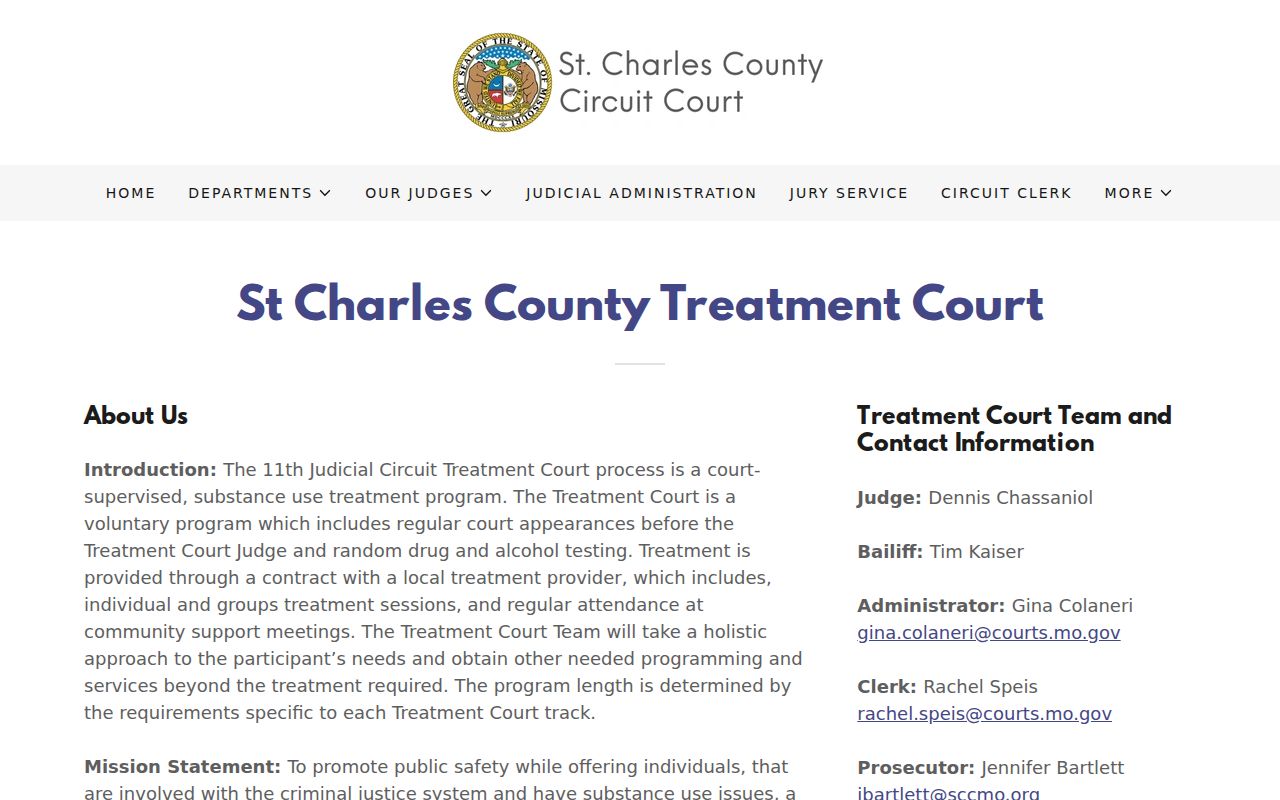
For a St. Charles County criminal docket search, rely on the underlying public case number. Program length, eligibility, and restricted treatment details should come from the division itself. A public search result will not answer those questions.
St. Charles County Criminal E-CASE Dockets
An E-CASE label has limits. It does not put every document on your phone. It only means the case file is electronic. Case.net Docket Entries still serve a St. Charles County criminal docket search well, but whether you can open a document depends on its security level, its age, and who you are in the case. Some eligible documents live only at a courthouse public-access terminal.
Missouri's 2023 remote-public-access expansion was anticipated for Circuit 11. It covered public documents filed on or after July 1, 2023. Anything earlier may still need the terminal. A clerk request is the other route. The Missouri eFiling System is the secure channel for registered filers, not the public docket. That split is why a docket entry can be visible while its attachment stays hidden.
St. Charles County Criminal Clerk Fallback
When Case.net falls short, the St. Charles County Circuit Clerk is the fallback. Try the courthouse public terminal or the copy counter in Room 217 for eligible records. The Circuit Clerk's copy and request page also covers closed-file email requests and criminal fax routing. Ask with a case number and a specific document description. Skip the vague request for the whole file.
Phone works too. The criminal division's main route is 636-949-7900, and the listed criminal fax is 636-949-7384. A mailed request is another documented option. It must clearly name the St. Charles County criminal case and the copy you need. Fees and access turn on the record. They also turn on whether you want a plain, certified, or restricted copy.
St. Charles County Criminal Record Status
A dismissal, nolle prosequi, or suspended sentence does not wipe the court record by itself. RSMo §610.105 covers certain dismissed, nolle-prossed, and suspended-sentence records. Expungement runs as a separate court process. After the applicable rule or order takes effect, a St. Charles County criminal docket may show only a limited status. It may also drop out of an ordinary public name search.
The official Missouri statute page that follows sets out that record-status rule. It is a good reminder. Read the final docket entry and the access level as two separate things.
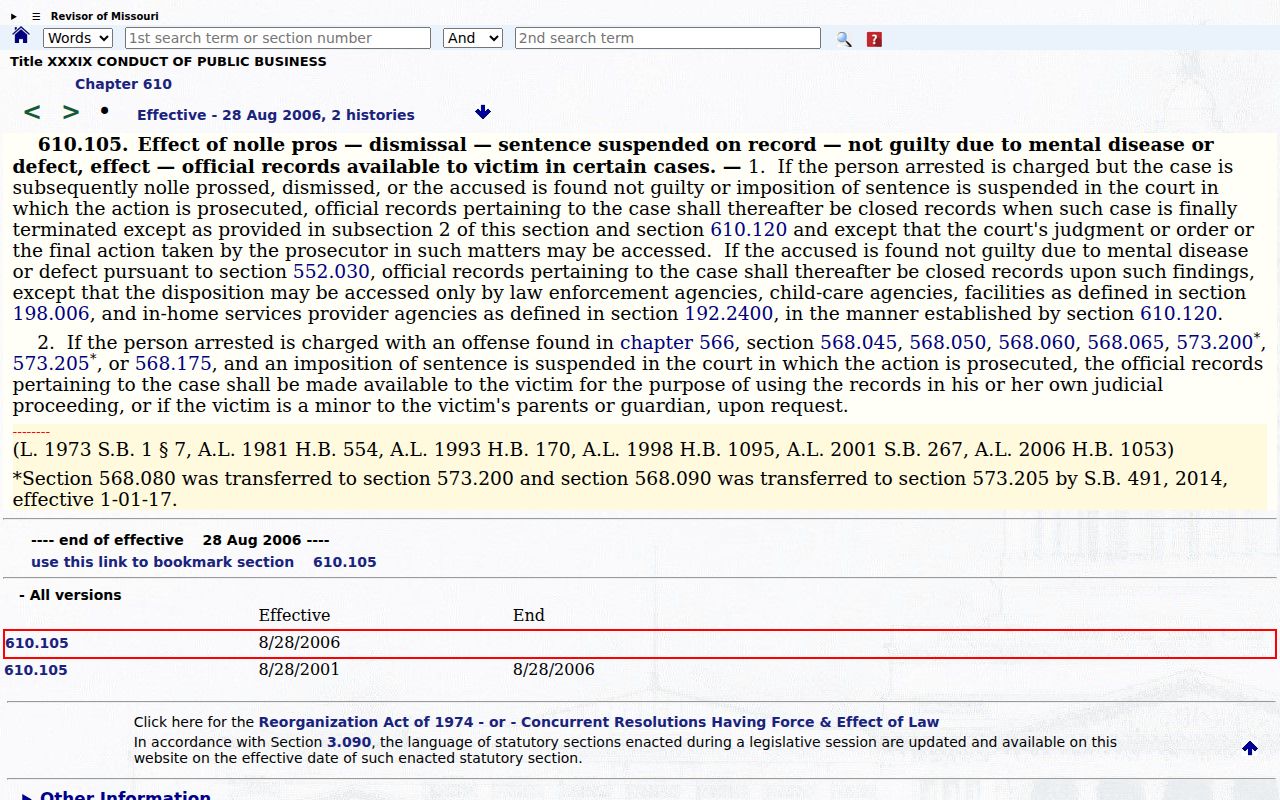
Need a current official copy? Give the Circuit Clerk the case number and a document description. The public chronology helps you locate the matter, but it cannot replace a clerk-authenticated record.
St. Charles County Criminal Docket Limits
Juvenile cases skip the ordinary public criminal docket path in St. Charles County. Missouri law and Supreme Court Rule 122 shield juvenile records and related family material, and Case.net can exclude the file from a normal name search. Confidential filing sheets add another layer, keeping Social Security numbers, dates of birth, and confidential addresses off the public display. The official juvenile-record statute is the source shown in the screen that follows.
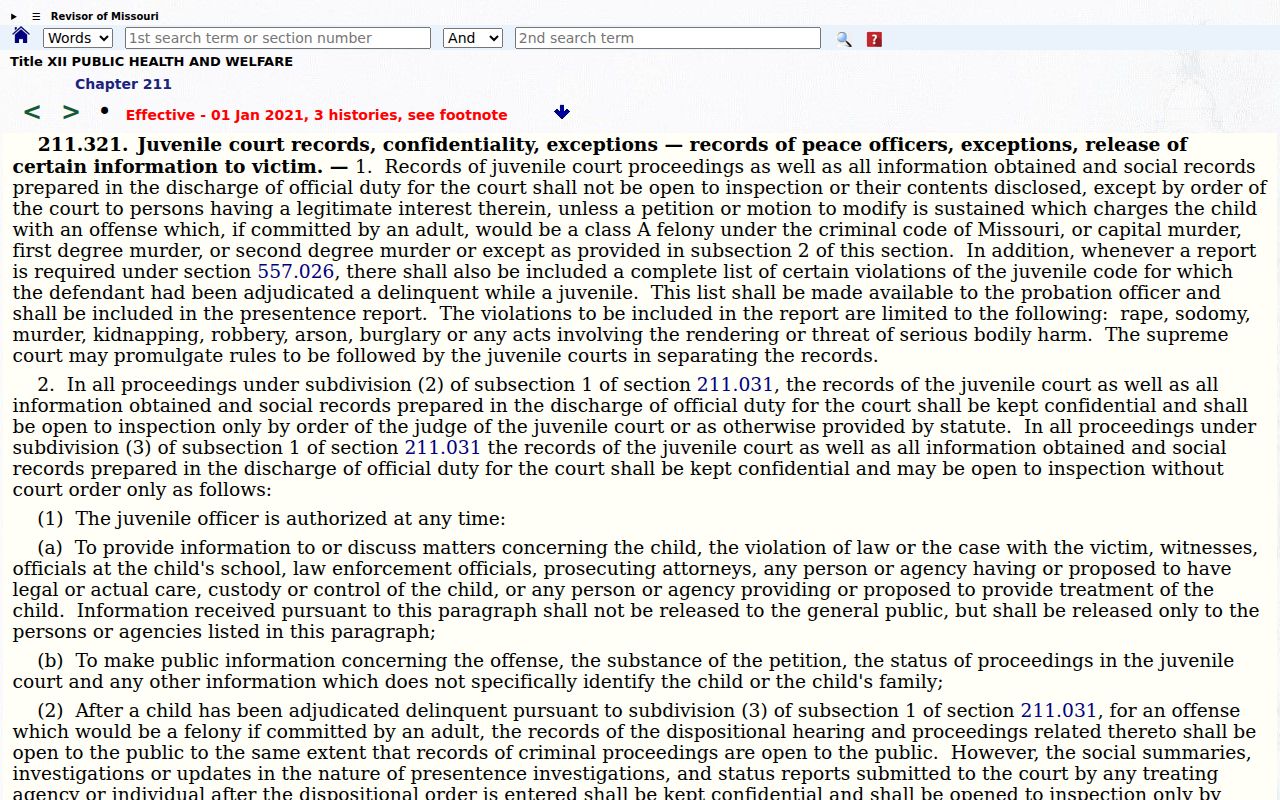
A public docket can hold confidential documents even though the case header is open to view. That happens in St. Charles County now and then. If the St. Charles County criminal docket returns nothing, double-check the case number and court, then ask the clerk about access rather than assuming the record is public.